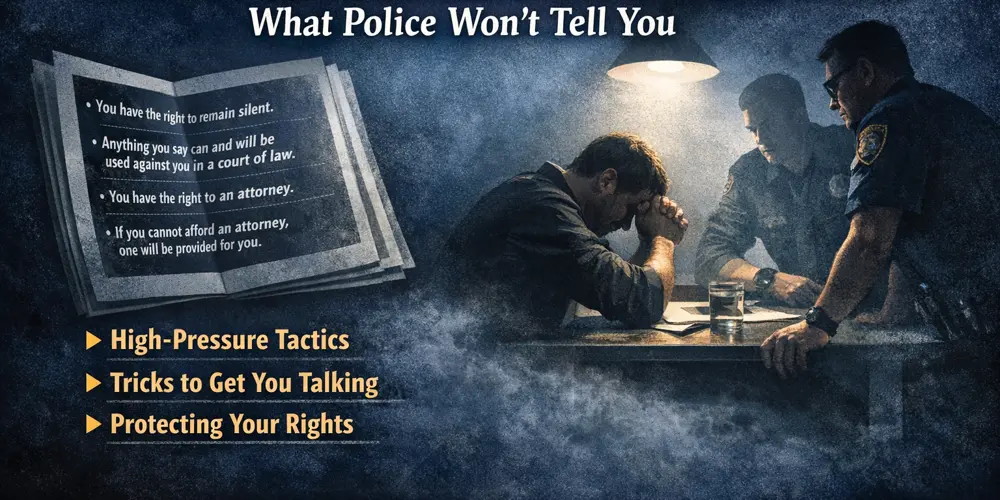
Knowing what police are required to tell you—and what they are not—can help you avoid common mistakes and better protect your rights.
What Are Miranda Rights?
Miranda rights come from the U.S. Supreme Court case Miranda v. Arizona. They are designed to protect your Fifth Amendment right against self-incrimination during custodial interrogation.
- You have the right to remain silent
- Anything you say can be used against you in court
- You have the right to an attorney
- If you cannot afford one, one will be provided
However, these rights only apply when you are both in custody and being interrogated.
What Police Won’t Tell You
While officers must read your Miranda rights in certain situations, they are not required to explain how those rights actually work in practice. This can lead to misunderstandings that harm your defense.
- You can invoke your rights at any time – Even if you start talking, you can stop and request a lawyer
- Silence must be clearly stated – Simply staying quiet is not always enough; you must explicitly say you are invoking your right
- Police can use tactics to encourage talking – Including minimizing the situation or suggesting cooperation will help
- Not all questioning requires Miranda warnings – If you are not technically “in custody,” statements can still be used against you
Common Interrogation Tactics in Sex Crime Cases
Sex crime investigations often rely heavily on statements. Because of this, interrogations are a key tool for law enforcement.
- High-pressure questioning to create stress or urgency
- Downplaying the situation to encourage admissions
- Suggesting evidence exists even when it may not
- Building rapport to gain trust and lower defenses
These tactics are legal in many cases, which is why understanding your rights is so important.
Why Statements Are So Important
In many sex crime cases, physical evidence may be limited or unclear. As a result, statements made during interrogation can become central to the prosecution’s case.
| Factor | Impact on Case |
|---|---|
| Confession or admission | Can significantly strengthen prosecution |
| Inconsistent statements | Can be used to challenge credibility |
| Silence or refusal to answer | May limit evidence available to prosecution |
| Recorded interviews | Often used as key evidence in court |
Sources: U.S. Supreme Court (Miranda v. Arizona), American Bar Association, DOJ interrogation guidelines
Why Immediate Legal Representation Matters
One of the most important steps you can take is requesting an attorney before answering any questions. Early legal involvement can help prevent damaging statements and ensure your rights are protected from the start.
- Prevents self-incrimination during questioning
- Ensures proper handling of evidence
- Helps identify unlawful interrogation tactics
- Can influence early case strategy
Even a short conversation with law enforcement can have long-term consequences if not handled properly.
Key Takeaways
- Miranda rights protect you, but only if you use them
- Police are not required to explain how to invoke your rights
- Statements made during interrogation can define your case
- Requesting a lawyer immediately is one of the safest decisions
FAQs
Do police always have to read Miranda rights?
No. Only when you are in custody and being interrogated. Otherwise, statements may still be used against you.
Can I stop answering questions after I start?
Yes. You can invoke your right to remain silent or request a lawyer at any time.
What happens if I talk without a lawyer?
Your statements can be used as evidence, even if you later change your story.
Can police lie during interrogation?
In many cases, yes. Officers may use deceptive tactics as part of questioning.
Is it better to stay silent?
In most situations, yes. Exercising your right to remain silent and requesting legal counsel is the safest approach.