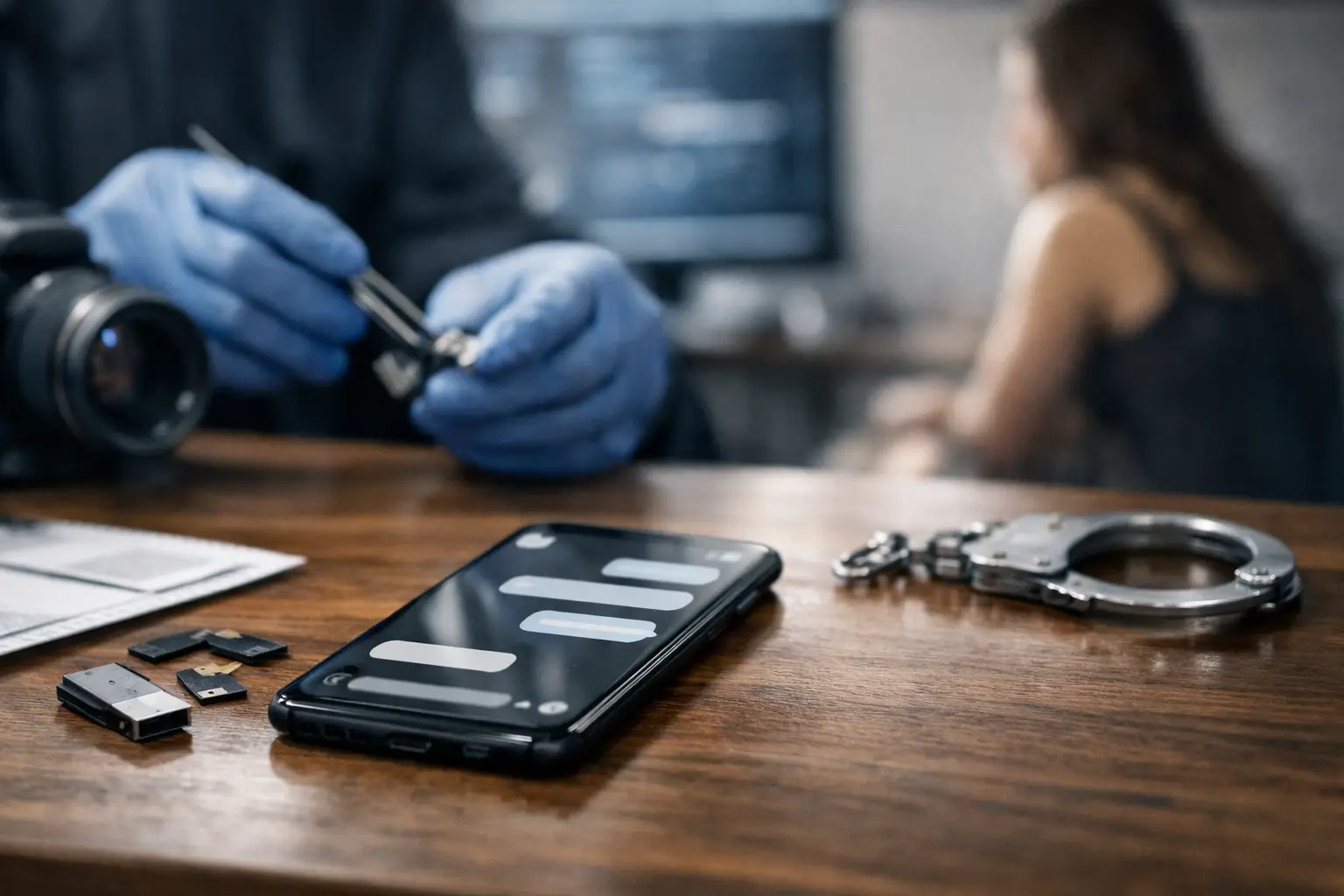
A deleted text can feel like a loose end. In a Florida sex crime investigation, it can become the center of the case. So, can deleted messages be recovered? Sometimes. But recovery is not automatic, and a recovered fragment is not the same thing as reliable, admissible proof.
Police, prosecutors, and accusers may treat digital evidence as decisive before anyone has tested how it was obtained, whether it is complete, or whether it actually came from the person accused. That is where a disciplined defense begins. The stakes are too high to guess, explain yourself away, or start changing anything on a phone.
Can Deleted Messages Be Recovered?
Deleted messages can sometimes be recovered from a phone, a cloud account, a backup, another person’s device, an app’s records, screenshots, or a forensic extraction. Whether recovery is possible depends on the device, the messaging platform, available backups, account settings, the time that has passed, and what happened after the message was deleted.
Deleting a message usually removes it from ordinary view. It does not necessarily erase every trace immediately. On some devices, the underlying data may remain in storage until it is overwritten. On others, modern encryption, automatic cleanup functions, and technical limits may make recovery difficult or impossible.
That uncertainty matters. An investigator may recover something, but not the entire conversation. A prosecutor may have screenshots but no original device. A message may appear in a backup with missing attachments, missing timestamps, or no surrounding context. Those gaps can be critical in a case built on allegations of sexual assault, sexual battery, online solicitation, CSAM, or lewd conduct.
Where Investigators May Look for Deleted Messages
A phone is only one possible source. Investigators may seek evidence from multiple places, each with different reliability issues and legal limits.
The Phone or Computer Itself
If law enforcement obtains a device, it may attempt a forensic extraction. Depending on the model, operating system, lock status, and condition of the device, an examiner may recover active messages, remnants of deleted data, app databases, notifications, images, location information, and account artifacts.
But forensic tools do not perform magic. Their results must be examined closely. Was the phone searched under a valid warrant or valid consent? Was the extraction complete? Did the software alter metadata during collection? Can the examiner explain the method and error rate? Did the report distinguish between a message visible on the device and a deleted record reconstructed from fragments?
Those questions are not technical distractions. They can determine whether evidence survives a legal challenge.
Cloud Backups and Synced Accounts
Messages may be copied to cloud backups, email accounts, tablets, laptops, or connected watches. An alleged victim may also have copies of the same communications. Some platforms retain certain account information while retaining little or no message content. Others may have backups only if the user enabled them.
The government generally cannot simply take what it wants because it suspects wrongdoing. Access to private accounts and stored information raises serious Fourth Amendment and statutory issues. The scope of any warrant matters. A warrant for certain messages is not a blank check to search every private photograph, note, contact, or file connected to a person’s account.
The Other Person’s Device
In credibility-driven cases, the accuser’s phone can be as important as the accused person’s phone. A screenshot may show a damaging sentence while concealing messages immediately before and after it. It may omit prior flirtation, later regret, requests for money, threats, inconsistent statements, or communications with third parties.
A real defense investigation does not accept a cropped image as the whole story. It demands context, original files where available, metadata, device access records, and a clear chain of custody.
Carriers, Apps, and Third Parties
Cell carriers often maintain call logs, text-routing information, and account records, but they may not retain the content of standard text messages for long, if at all. Messaging apps operate differently. Some use end-to-end encryption, some allow backups, and some preserve limited records that may still place an account at a particular time or connect it to a device.
Third-party records may corroborate a timeline, or they may expose one as false. The point is simple: an accusation based on one selected digital item should never be treated as the final word.
Recovery Does Not Prove What the State Wants It to Prove
Even if deleted messages are recovered, the state still has work to do. It must establish authenticity, attribution, relevance, and context. A message from an account is not automatically proof of who typed it. A device can be shared, left unlocked, accessed by another person, or connected to multiple accounts. Screenshots can be cropped, edited, or misunderstood.
Timing also matters. A timestamp may reflect when a device recorded or synced data, not necessarily when a person sent or read a message. An image may be forwarded repeatedly. A contact name can be changed. A message thread can be incomplete because of disappearing-message settings, software problems, or selective preservation.
In sex crime cases, prosecutors often use digital communications to argue intent, consciousness of guilt, coercion, or a pattern of conduct. That makes context non-negotiable. A defense attorney must look for what is missing, what changed, who controlled the evidence, and whether the state can prove its interpretation beyond a reasonable doubt.
What to Do If Deleted Messages May Be Part of an Investigation
Do not panic and start cleaning up your devices. Do not delete more material, reset a phone, remotely wipe a device, change accounts, or tell another person what to say. Those decisions can create new problems and may be portrayed as an attempt to destroy evidence.
Do not contact the accuser to demand an explanation, ask them to recant, or try to recover messages yourself. A call, text, social media message, or request through a friend can be twisted into witness tampering, harassment, retaliation, or consciousness of guilt. If there is an injunction, bond condition, or no-contact order, violating it can put you back in custody.
Also, do not hand over your phone voluntarily just because an investigator says cooperation will make the situation disappear. You may have rights, and a consent search can expose far more than the investigator initially describes. Be respectful. Say you want to speak with an attorney. Then stop talking about the facts.
Preserve what you have without altering it. Keep the device charged and secure. Make a written timeline for your attorney while events are fresh, including names, dates, locations, apps used, and anyone who may have relevant information. Do not send that timeline around to friends or family. Attorney-client confidentiality is not created by discussing a case with everyone close to you.
How a Strong Defense Challenges Digital Evidence
A serious defense does not wait for the prosecution to define the evidence. It moves quickly to preserve favorable material and test the state’s theory before memories fade and data disappears.
That may include examining whether police had lawful authority to seize and search a device, reviewing warrant language, challenging an overbroad search, scrutinizing forensic reports, and demanding the original data behind screenshots. It may also mean locating witnesses, obtaining records that establish the true timeline, and exposing inconsistencies between an accusation and the digital record.
In some cases, the best issue is that deleted material cannot be recovered and the state is asking a jury to speculate. In others, the issue is that messages were recovered selectively and stripped of their actual meaning. Every case turns on its own facts, technology, and procedural history. There is no safe assumption that a deleted message is gone forever or that recovery ends the fight.
George Law approaches digital evidence the way high-stakes allegations demand: aggressively, early, and without accepting the government’s version of the facts. When your freedom, career, family, and reputation are under attack, delay gives the other side time to build a narrative around evidence that may be incomplete or unreliable.
If investigators have contacted you, seized a device, served a warrant, or suggested they have recovered deleted communications, treat it as an immediate legal threat. Protect the device, protect your rights, and get defense counsel involved before you say or do something the state can use against you.