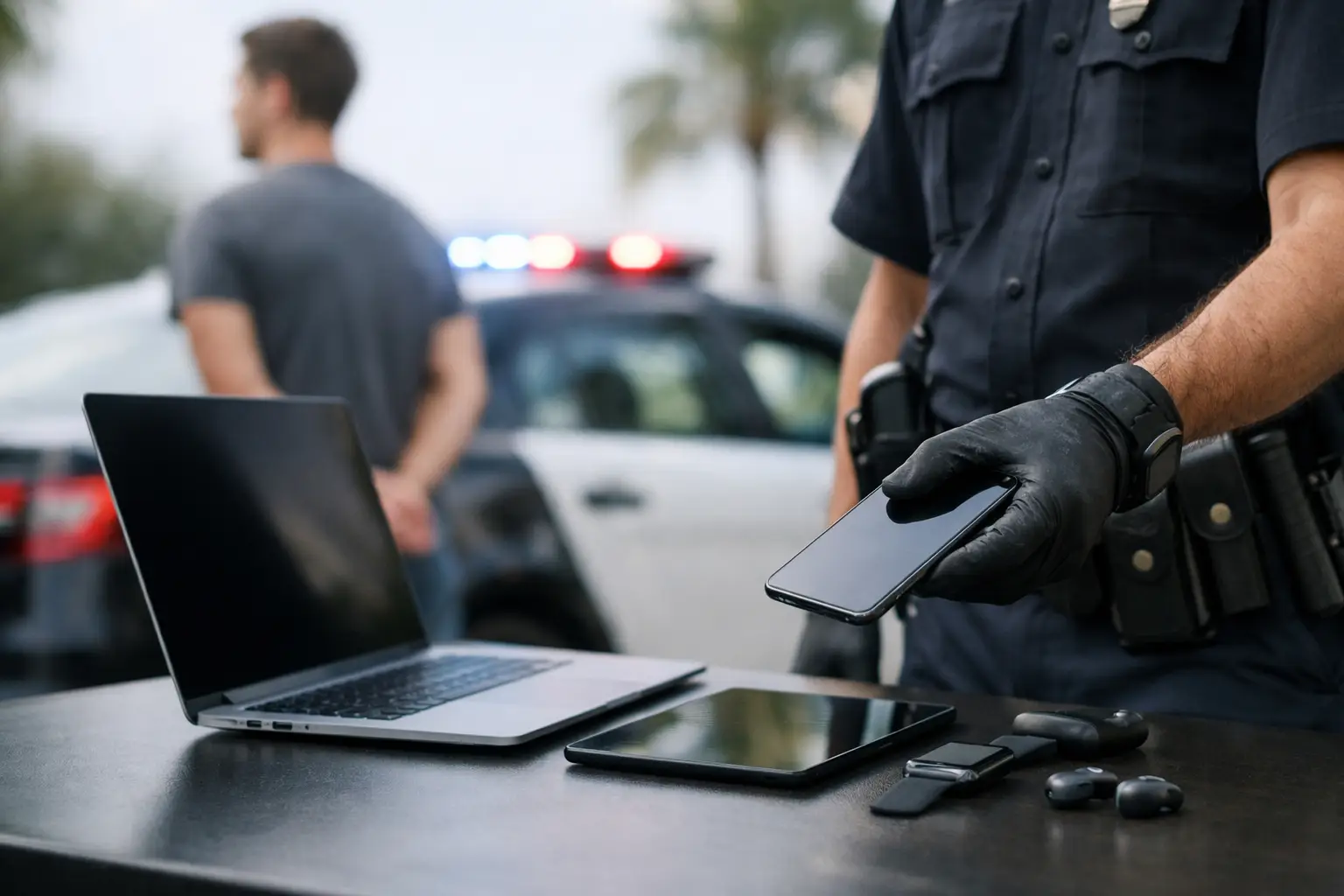
A detective at your door wants your phone. Another officer says they only need to “take a quick look” at your laptop. Your instinct may be to cooperate, explain, or hand over the device to prove you have nothing to hide. That is exactly when you need to slow down. Can police seize your devices? Sometimes. But police do not get unlimited access to the digital record of your life simply because they ask, accuse you, or open an investigation.
For men facing sex crime allegations in Miami or anywhere in Florida, a phone, computer, tablet, gaming console, cloud account, or external drive can become the center of the case. Those devices may contain private conversations, photos, location data, searches, files, and account access that prosecutors will try to turn into a narrative. The moment law enforcement targets your electronics, the fight over evidence has begun.
Can Police Seize Your Devices in Florida?
Police can seize a device in certain circumstances, but seizure and searching are not the same thing. Officers may sometimes take physical possession of a phone or computer to preserve possible evidence. Searching its contents, however, generally requires a warrant that specifically authorizes the search or a recognized exception to the warrant requirement.
The Fourth Amendment protects people from unreasonable searches and seizures. Florida law provides similar protections. In real life, though, those protections only matter if someone forces the state to justify what it did. Prosecutors will often argue that an officer had consent, probable cause, an emergency, or another legal basis for acting without first obtaining a warrant.
That argument is not automatically right. The facts matter: what officers knew at the time, what they said, whether you were free to leave, whether anyone consented, how broadly a warrant was written, and how investigators handled the device after taking it.
When Police May Take a Phone, Computer, or Tablet
A valid search warrant is the most common path. To obtain one, law enforcement must present a judge with sworn facts establishing probable cause that evidence of a crime will be found in a particular place or device. The warrant should identify what may be seized and searched with enough specificity to limit a general rummaging expedition.
In a digital sex crime investigation, police may seek a warrant for a particular phone, computer, storage device, or account. They may claim the device contains messages, images, app data, browser activity, location history, or communications with an alleged victim. A judge’s signature does not end the analysis. The warrant application may rely on weak assumptions, stale information, misleading statements, or facts that do not actually tie the device to criminal conduct.
Police may also seize devices during a lawful arrest or during execution of a warrant at a home. But an arrest does not give officers a blank check to scroll through a phone. Courts recognize that smartphones hold an extraordinary volume of private information. In most situations, officers need a separate warrant to search the phone’s digital contents, even if they lawfully took the phone from your person.
There are exceptions. If someone voluntarily consents to a search, police may rely on that consent. If officers reasonably believe immediate action is necessary to prevent destruction of evidence or respond to a genuine emergency, they may assert exigent circumstances. Devices in plain view may be seized when their evidentiary value is immediately apparent. A person on probation or subject to specific search conditions may have reduced privacy protections.
Those exceptions are narrow in theory and often stretched in practice. “Just let us look” is not a legal standard. Neither is pressure, intimidation, or a vague promise that cooperation will make the problem disappear.
Consent Is Often the Trap
Consent can be verbal. It can be written. It can be implied from conduct. That is why casually handing an officer an unlocked phone, giving a passcode, or saying “go ahead” can create serious problems.
You have no duty to volunteer consent to a search of your device. You can state clearly: “I do not consent to any search or seizure. I want to speak with my lawyer.” Do not argue, resist, delete material, or interfere physically with officers. Preserve your rights without creating a new allegation.
If police already have a warrant, do not obstruct them. Ask to see it if possible, say that you do not consent beyond the warrant, and contact defense counsel immediately. A lawyer can evaluate whether the warrant actually covered the device, the location, the type of data, and the scope of the forensic search.
A Seized Device Does Not Mean the Search Was Lawful
A phone may be taken lawfully but searched unlawfully. A warrant may authorize a search for certain evidence but not every account, file, message, or time period on the device. Investigators may exceed the warrant’s scope, use an invalid warrant, delay unreasonably before obtaining judicial authorization, or rely on a consent claim that was not truly voluntary.
Digital evidence also creates technical questions that matter. Who possessed the device? Who knew the passcode? Was the account shared? Was a file actually downloaded, viewed, sent, or merely cached? Did forensic software preserve metadata accurately? Could someone else have used the Wi-Fi network, cloud account, or computer profile?
In internet sex crime and CSAM cases, the prosecution may present device evidence as if it speaks for itself. It does not. Data requires interpretation. A file name is not proof of knowledge. An IP address is not proof of identity. An allegation tied to an account is not proof that a particular person created, sent, or received the content at issue.
A serious defense examines the warrant, the affidavit, the chain of custody, extraction reports, forensic methods, login history, and every claimed link between the accused and the device. The state has the burden. It does not get to fill gaps with suspicion, public pressure, or a detective’s theory.
What to Do If Police Ask for Your Devices
The first minutes can shape the entire case. Do not try to outtalk investigators. Do not consent to a search because you believe you can explain everything later. Once information is exposed, it cannot be put back.
Use a calm, controlled response. Ask whether you are being detained or whether officers have a warrant. State that you do not consent to a search. Invoke your right to remain silent and request a lawyer. Then stop discussing the facts.
Do not destroy, wipe, hide, encrypt after the fact, or remotely alter data. Do not tell anyone else to do it. That can create separate criminal exposure and may be used to suggest consciousness of guilt. Do not communicate with an accuser, alleged victim, witness, or anyone you believe may be cooperating with law enforcement. A message meant to “clear things up” can become the next exhibit against you.
If devices have already been taken, write down what happened while it is fresh: the officers’ names and agencies, the time, the location, what they said, what you said, whether they showed a warrant, and every item removed. Save paperwork, receipts, inventories, and notices. Do not post about the investigation or use social media to defend yourself.
The Defense Starts Before Charges Are Filed
Many people wait until an arrest or formal charge to call a lawyer. That delay gives investigators time to obtain warrants, interview witnesses, extract data, and build a one-sided record without resistance. In a high-stakes allegation, early legal intervention can matter more than a speech in court months later.
A defense lawyer can communicate with investigators, assess whether contact is necessary, review warrants and inventories, move to protect constitutional rights, preserve favorable evidence, and prepare for the fight over digital proof. Not every seizure leads to charges. Not every search survives scrutiny. But waiting quietly and hoping the government loses interest is not a strategy.
If police want your phone, computer, or accounts, treat the situation for what it is: a direct threat to your privacy, reputation, and freedom. Keep control of your words, do not consent blindly, and get experienced criminal defense counsel involved before the state decides the story your devices will tell.